
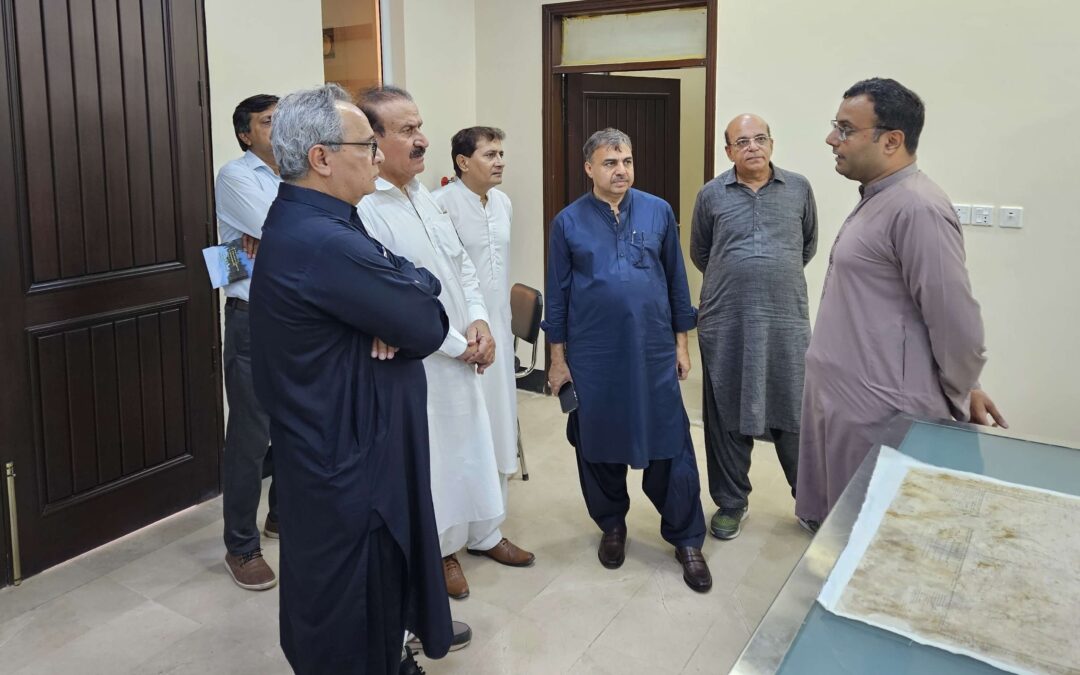
The Exploration and Excavation Branch’s Archaeological Research and Conservation Laboratory was honored to host renowned social activist, advocate & writer Mr. Shabir Shar. Accompanied by Roshan Ali Kanasro, Director Mr. Zaheer Ahmed Shaikh, Deputy Director of the Exploration and Excavation Branch, Aamir Ahmed Memon, Field Officer, Hasseb u Rahman, Field Officer, Mehar Ali, Archaeologist (PhD scholar), and Muhammad Shah Bukhari, Mr. Shar toured our state-of-the-art facilities.
During the visit, Mr. Shar received an in-depth briefing on our laboratory’s unique projects and achievements. Our team highlighted the meticulous processes involved in restoring ancient ceramics and metal objects, with a particular emphasis on our innovative method of cleaning ancient copper coins. This restoration work, unique to our laboratory, exemplifies our commitment to preserving artifacts of immense historical and cultural significance.
Our laboratory also showcased its crucial role in paper conservation, including topographical maps, which are essential tools for understanding historical landscapes. Our digital documentation efforts play a pivotal role in ensuring that our nation’s rich heritage is not only preserved but also made accessible to future generations.
Our laboratory handles antiquities from a wide array of civilizational and historical backgrounds, from the Stone Age and the Indus Valley Civilization to more recent periods. Our work in documenting and restoring these artifacts helps to illuminate our country’s diverse and rich history.
Mr. Shar expressed his admiration for the unwavering dedication and expertise demonstrated by our team. He praised the excellence of our restoration techniques and the thorough documentation processes we employ. He was particularly impressed by the range of historical periods covered by our work and the importance of preserving these links to our past.
During the tour, Mr. Shar was introduced to several advanced machines and tools used in our laboratory, including:
- Fume Hood: Protects researchers from harmful fumes and vapors during the chemical process. It is essential for safe handling and applying chemical treatments to artifacts during restoration.
- Laminar Air Flow: Provides a clean, sterile environment for handling sensitive artifacts; crucial for working with fragile items that require a contamination-free setting, such as ancient textiles, papers, or delicate ceramics.
- Ultrasonic Cleaner: Uses ultrasonic waves to clean artifacts without damaging them; effective for removing dirt and corrosion from metal objects, coins, and intricate ceramics.
- Distillation Apparatus: Produces pure solvents and chemicals needed for conservation, ensuring the purity of materials used to clean and preserve artifacts.
- Spectrophotometer: Analyzes the composition of materials by measuring light absorption; identifies the elemental makeup of artifacts, aiding their authentication and conservation.
- Drying Oven: Used for controlled drying of artifacts after wet cleaning or chemical treatment; prevents moisture damage and ensures proper drying for long-term preservation.
- Weight Analysis Scales: Precisely measure the weight of artifacts and samples; important for documenting the mass of artifacts and ensuring accurate chemical formulation in conservation treatments.
- Digital Imaging Systems: High-resolution cameras and imaging software document artifacts in detail. These digital records are vital for both research and public dissemination.
The visit was a momentous occasion for our laboratory. Mr. Shar’s acknowledgment of our efforts not only serves as a powerful endorsement of our mission but also significantly boosts the morale of our team. The presence of his esteemed delegation further underscores the critical nature of the work being cared out at the Exploration and Excavation Branch.
The entire team at the laboratory is deeply grateful for Mr. Shar’s visit and his encouraging words. His recognition not only reaffirms the significance of our work but also strengthens our resolve to continue our pursuit of excellence in the field of archaeological conservation and research.